
Cardiology & Electrophysiology
Neurology
Primary & Integrative Care
Pain & Chiropractic
Longevity & Wellness
Research & Clinical Trials
Who We Serve · Cardiology
ANS Monitoring for Cardiology
Quantify the autonomic contribution to dysrhythmia, syncope, and heart failure by independently measuring both branches of the autonomic nervous system, providing objective data to support clinical assessment and patient management.
See the technology live in a 60-minute
virtual session.

— Who We Serve · Cardiology
ANS Monitoring for Cardiology
Quantify the autonomic contribution to dysrhythmia, syncope, and heart failure by independently measuring both branches of the autonomic nervous system, providing objective data to support clinical assessment and patient management.
See the technology live in a 60-minute virtual session.
— Who Uses Physio PS
Trusted by Leading Health
Systems and Universities
Sampling of Customers across the US and internationally.
Hospital Systems (9)
-NYU Langone, NY
-JFK Hospitals, NY
-Hackensack Meridian Health, NJ
-Emory Hospital, GA
-Main Line Health, PA
-Boston Children's Hospital, MA
-Mass General, MA
-UZ Brussel, Belgium
-EpiCura, Belgium
Government (3)
-Atlanta VA Medical Center, GA
-East Orange VA, NJ
-Walter Reed National Military Medical Center, MD
Universities and Medical Schools (16)
United States
-Stanford University, CA
-USC, CA
-University of Michigan, MI
-University of Alabama, AL
-University of Louisville, KY
-Temple University, PA
-Eastern Virginia Medical School, VA
-Augusta University
-Logan University
-Boston Children's Hospital, Harvard, MA
International
-Cornell University, Qatar
-University of Adelaide, Australia
-University of Manchester, UK
-University of Zagreb, Croatia
-Medical University of Sofia, Bulgaria
-Deutsches Diabetes-Zentrum, Germany
Doctors' Offices and Groups (25)
-Franklin Cardiovascular, NJ
-Wellstar Cardiovascular Medicine, GA
-Fawaz Medical and Surgical Clinic, FL
-Queens Medical NYC, NY
-Nemechek Autonomic Medicine, AZ
-Luminary Clinics, NH and SC
-Luminary Mexico
-Clinica Cardiovascular, PR
-Dr. Ramesh K. Adiraju, MD, NJ
-Dr. Antonio V. Baute, GA
-Dr. Alan Vinitsky, MD
-Dr. Christopher Droogan, PA
-Dr. Suketu Nanavati, NJ
-Dr. Michael Weintraub, NY
-Dr. Gerald Smith, PA
-Dr. Karabach, MD, NJ
-Delvis A. Celdran, MD PA, FL
-Dr. Ramon Castello, FL
-Dr. Kavtaradze, FL
-Dr. MaryBeth Ayer, FL
-Dr. Robin Hall, HI
-Dr. Swamy Venuturupalli, CA
-Dr. Jitendra Patel, OR
-Dr. Trabanco, PR
-Dr. Reillo, PR
-Dr. Anja, Australia
— The Unsolved Cases
Every Medical Professional Has the Patients They Could Not Close the Loop On

The POTS case that bounced between cardiology and psychiatry. The Long-COVID or PTSD patient whose labs come back normal while the symptoms stay real. The patient who has already seen everyone and tells you so.
Those visits cost time, and they leave without an answer or a follow-up. Autonomic dysfunction affects an estimated 90 million people, and most of it is never measured. When you can measure it, the unsolved case becomes a solved one, and a referral source.
POTS, differentiated from syncope by the direction of the sympathetic response to standing
Long-COVID, with the autonomic component quantified when standard testing reads normal
PTSD, where the quality-of-life symptoms are autonomic and therefore measurable
Forty-three conditions in total, each with the parasympathetic or sympathetic pattern behind it
— Clinical impact
50+ Conditions. One Platform.
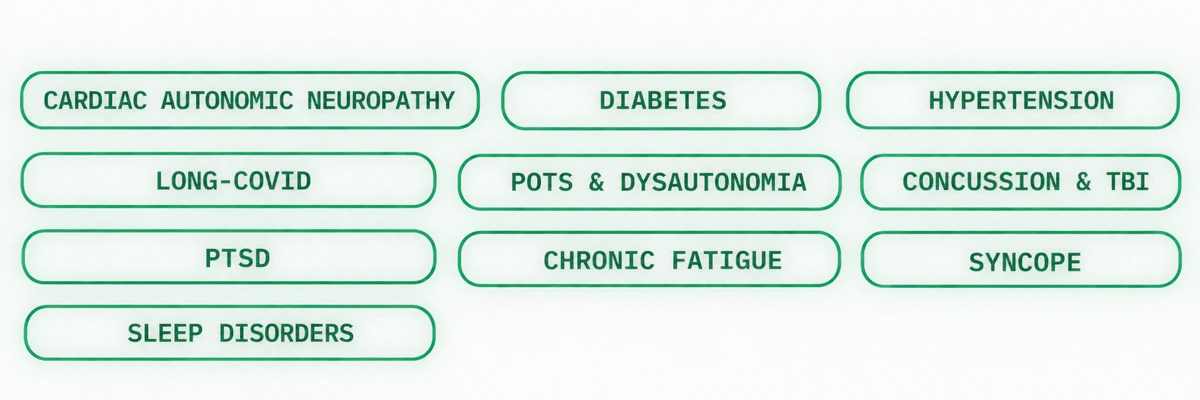
ANS testing provides physicians with actionable data across an unprecedented spectrum of diseases and disorders, many of which go undetected by standard diagnostic methods.

Clinical Monitoring Unit (CMU)
The Clinical Monitoring Unit is a desktop-based ANS monitoring system designed for any clinic environment. FDA 510(k) cleared and supported by fundable billing codes, the CMU gives your practice a deeper look at autonomic function, while opening a new, supportable revenue stream.

ANS Monitoring Integration
ANS monitoring integration from Physio PS helps medical practices add autonomic function testing to existing treatment protocols, with automated workflows, patient-facing reports, and clinical guidance included. No complex setup, no steep learning curve, and potential for cash-based add-on services

Remote Monitoring Unit (RMU)
The Remote Monitoring Unit is a portable, tablet-based ANS monitoring system built for in-home care providers and sports medicine practitioners. Battery-powered and compact, it brings the same complete autonomic function testing to any setting, without being tethered to a clinic.

Portable Autonomic Lab (PAL)
The Portable Autonomic Lab is a laptop-based ANS monitoring solution built for the medical professional who moves between facilities or works in the field. Multiple power options and a compact form factor mean you get complete autonomic function testing wherever the work takes you.

Research Software Program (Physio PS 4.0)
Physio PS 4.0 is a research-grade ANS software program available to approved researchers on a one-year renewable license. Built on the same platform trusted by physicians worldwide, it gives research teams the autonomic monitoring tools needed for rigorous, publishable work.
— The Clinical Case
Where Heart Rate Variability Stops Short
Most autonomic tools report a single blended figure, or measure the sympathetic branch alone. Heart rate variability tells you something is off without telling you which branch is driving it, and most drugs and diseases affect only one of the two.
P&S monitoring resolves both branches independently and simultaneously, so the question moves from how active the system is to how the two sides relate. In cardiology that distinction decides therapy.
Roughly 80% of atrial dysrhythmias involve the P&S systems; monitoring specifies which branch, rather than treating all of them as cardiogenic
Congestive heart failure shows a rising sympathetic baseline up to four days before the 3% weight-gain indicator, leaving room for a temporary diuretic increase instead of a hospitalisation
Vasovagal, neurogenic and cardiogenic syncope separate on the stand response, where tilt-table struggles to differentiate
Cardiovascular autonomic neuropathy is identified early, when the mortality risk is still modifiable
— The Clinical Case
Where Heart Rate Variability
Stops Short
Most autonomic tools report a single blended figure, or measure the sympathetic branch alone. Heart rate variability tells you something is off without telling you which branch is driving it, and most drugs and diseases affect only one of the two.
P&S monitoring resolves both branches independently and simultaneously, so the question moves from how active the system is to how the two sides relate. In cardiology that distinction decides therapy.
Roughly 80% of atrial dysrhythmias involve the P&S systems; monitoring specifies which branch, rather than treating all of them as cardiogenic
Congestive heart failure shows a rising sympathetic baseline up to four days before the 3% weight-gain indicator, leaving room for a temporary diuretic increase instead of a hospitalisation
Vasovagal, neurogenic and cardiogenic syncope separate on the stand response, where tilt-table struggles to differentiate
Cardiovascular autonomic neuropathy is identified early, when the mortality risk is still modifiable
— CONDITIONS
Cardiology Conditions Where Both Branches Matter
Each entry notes the parasympathetic or sympathetic pattern that monitoring resolves.
Hypertension
Typically characterised by sympathetic excess driving up the baroreceptor reflex, beginning with a decline in resting parasympathetic activity.
Cardiac Dysrhythmias
About 80% of atrial dysrhythmias involve the P&S systems; only 20% are purely cardiogenic.POTS
The sympathetic response to standing is quantified, differentiating orthostatic dysfunction from syncope.
Cardiomyopathy
Characterised by sympathetic excess; forms may turn symptomatic when orthostatic dysfunction or syncope appears.
Congestive Heart Failure
High sympathetic baseline precedes even the 3% weight-gain indicator, by up to four days.
Syncope and Collapse
Monitoring positively identifies vasovagal and neurogenic syncope and separates the neuro component from the cardio.Angina
A function of sympathetic excess, from excess vasoconstriction or atherosclerotic build-up.
Post-MI
Myocardial infarction causes sympathetic excess, and post-MI symptoms follow from it.
— In the Room
What the Visit Looks Like
Patient seated, leads placed
A heart rate monitor, ECG leads and a blood pressure cuff. Nothing invasive, no tilt table.
Fifteen minutes of recording
Resting baseline, then a short series of standard challenges: paced breathing, Valsalva, and a head-up postural change.
Both branches resolved separately
The software measures RFa and LFa, giving parasympathetic and sympathetic activity as two independent readings.
Report before the patient leaves
Qualitative, quantitative and graphical output, ready for your review and for the patient to take home.
— Billing and Setup
Supported by Fundable Billing Codes
The assessment is supported by fundable billing codes, adding a documented revenue stream to your practice without adding staff burden.
Training and certification are included, so your team is ready from day one.
Ask about billing code applicability for your specialty during your demo.
✓ FDA 510(k) Cleared
✓ Patented Technology
✓ Backed by Published Research
See the Cardiology Workflow Live
See the technology live in a 60-minute virtual session.
✓ FDA 510(k) Cleared ✓ Patented Technology ✓ Backed by Published Research ✓ In Business Since 2019
— Next Step
Start Where It Makes Sense for You
FDA 510(k) cleared autonomic nervous system monitoring for clinics, home care and research. Serving physicians, clinics and researchers across the United States and worldwide.
Site
Who We Serve
Journal
Contact
603-287-1817
80 Nashua Rd, Building C, Unit G1, Londonderry, NH 03053
© 2026 Physio PS, Inc. All rights reserved. FDA 510(k) cleared · Patented · Established 2019.
Hours available on request, ask during your demo.
Copyright 2026 Physio PS, Inc. All Rights Reserved.
The material and information provided by Physio PS is for general information purposes only. You should not rely upon this material or information for basis of making healthcare, treatment, or diagnosis decisions. While Physio PS strives to provide the most correct and up-to-date information and data, Physio PS makes no representations or warranties of any kind, expressed or implied, about the completeness, accuracy, reliability, suitability, or availability with respect to the information, products, services, or related graphics contained. Any reliance placed on such material is therefore strictly at your own risk. Reporting Information is supplied under license by NCRC LLC. * ‘RFa’ is known to be a measure of Parasympathetic activity and ‘LFa’ is known to be a measure of Sympathetic activity, based on reference: Colombo J, Arora RR, DePace NL, Vinik AI, Clinical Autonomic Dysfunction: Measurement, Indications, Therapies, and Outcomes. Springer Science + Business Media, New York, NY; 2014.
— FAQ
Questions Practices Ask Before They Start
Straight answers on time, cost, clearance and fit.
How long does an assessment take?
A complete autonomic assessment is non-invasive and takes 15 minutes. It is fully automated, and the qualitative, quantitative and graphical reports are delivered without manual interpretation.
Is the technology FDA cleared?
Yes. The platform is FDA 510(k) cleared to U.S. medical device standards, patented, and backed by published research.
How is testing paid for?
The Clinical Monitoring Unit is supported by fundable billing codes. For the other systems, ask about billing code applicability during your demo. Financing options, low monthly payments and veteran-owned discounts are available to qualifying practices.
Do we need extra staff, space or a tilt table?
No. Testing integrates with your existing treatment protocols with no workflow overhaul and no tilt table required. Training and certification are included, so your team is ready from day one.
How is this different from heart rate variability tools?
It is the only solution on the market that measures both parasympathetic and sympathetic branches independently, simultaneously and quantitatively, rather than reporting one blended figure.
Which system fits my practice?
The CMU is a desktop system for clinics, the RMU is tablet-based and battery-powered for home care and sports medicine, and the PAL is laptop-based for medical professionals who move between facilities. A free demo is the quickest way to find the right configuration.
How do I become a distributor?
Tell us about your territory and the clinics you work with through the distributor enquiry form, or call 603-287-1817, and the team will follow up to discuss distribution.
See the Cardiology Workflow Live
See the technology live in a 60-minute virtual session.
— Next Step
Start Where It Makes Sense for You
FDA 510(k) cleared autonomic nervous system monitoring for clinics, home care and research. Serving physicians, clinics and researchers across the United States and worldwide.
Site
Who We Serve
Journal
Contact
603-287-1817
80 Nashua Rd, Building C, Unit G1, Londonderry, NH 03053
© 2026 Physio PS, Inc. All rights reserved.
FDA 510(k) cleared · Patented · Established 2019.
Hours available on request, ask during your demo.
Copyright 2026 Physio PS, Inc. All Rights Reserved.
The material and information provided by Physio PS is for general information purposes only. You should not rely upon this material or information for basis of making healthcare, treatment, or diagnosis decisions. While Physio PS strives to provide the most correct and up-to-date information and data, Physio PS makes no representations or warranties of any kind, expressed or implied, about the completeness, accuracy, reliability, suitability, or availability with respect to the information, products, services, or related graphics contained. Any reliance placed on such material is therefore strictly at your own risk. Reporting Information is supplied under license by NCRC LLC. * ‘RFa’ is known to be a measure of Parasympathetic activity and ‘LFa’ is known to be a measure of Sympathetic activity, based on reference: Colombo J, Arora RR, DePace NL, Vinik AI, Clinical Autonomic Dysfunction: Measurement, Indications, Therapies, and Outcomes. Springer Science + Business Media, New York, NY; 2014.