
Cardiology & Electrophysiology
Neurology
Primary & Integrative Care
Pain & Chiropractic
Longevity & Wellness
Research & Clinical Trials
Who We Serve · Primary & Integrative Care
ANS Monitoring for Primary and Integrative Care
Assess the parasympathetic and sympathetic branches of the autonomic nervous system independently to gain objective insights into autonomic function and better understand symptoms such as fatigue, anxiety, dizziness, and other complex health concerns.
See the technology live in a 60-minute
virtual session.


— Who We Serve ·
Primary & Integrative Care
ANS Monitoring for Primary and Integrative Care
Assess the parasympathetic and sympathetic branches of the autonomic nervous system independently to gain objective insights into autonomic function and better understand symptoms such as fatigue, anxiety, dizziness, and other complex health concerns.
See the technology live in a 60-minute virtual session.
— The Clinical Case
The Complaints That Arrive Without a Test
Fatigue, lightheadedness, palpitations, poor sleep, and anxiety are common concerns in primary care, yet they often go without objective measurement. Autonomic dysfunction affects an estimated 90 million people, and much of it remains unassessed.
Non-invasive autonomic testing measures both branches of the autonomic nervous system quantitatively, providing objective data that can help providers better understand these complaints and document findings to support clinical assessment.
A documented, objective result behind symptoms that otherwise get managed empirically
Integrates into existing treatment protocols with no workflow overhaul and no tilt table
Opens a new, supportable revenue line backed by fundable billing codes
Opens cash-based add-on services: biofeedback and recovery coaching, preventive screenings, performance optimisation

— The Clinical Case
The Complaints That Arrive Without a Test

Fatigue, lightheadedness, palpitations, poor sleep, and anxiety are common concerns in primary care, yet they often go without objective measurement. Autonomic dysfunction affects an estimated 90 million people, and much of it remains unassessed.
Non-invasive autonomic testing measures both branches of the autonomic nervous system quantitatively, providing objective data that can help providers better understand these complaints and document findings to support clinical assessment.
A documented, objective result behind symptoms that otherwise get managed empirically
Integrates into existing treatment protocols with no workflow overhaul and no tilt table
Opens a new, supportable revenue line backed by fundable billing codes
Opens cash-based add-on services: biofeedback and recovery coaching, preventive screenings, performance optimisation
— CONDITIONS
Primary Care Conditions Where Autonomic Data Helps
Drawn from the full index of forty-three, these are the presentations most common in general practice.
Diabetes
Both types are characterised by sympathetic excess, then by the continuing effects of sugar acidosis on the vagus nerve.
Post-COVID / Long-COVID
Autonomic dysfunction from a variety of causes, including the diagnosis and treatment of post-COVID symptoms.
Anxiety and Depression
Two measurable patterns rather than one diagnosis of exclusion.
Dizziness and Lightheadedness
Multiple causes, especially in geriatrics; monitoring separates the autonomic component.
Thyroid Disorders
Hyperthyroidism is characterised by sympathetic excess, hypothyroidism by parasympathetic excess.
Hypertension
Sympathetic excess drives up the baroreceptor reflex, beginning with a decline in resting parasympathetic activity.
Sleep Disorders
Night-time sleeplessness is associated with sympathetic excess; daytime sleepiness with parasympathetic excess.
Irritable Bowel Syndrome
Constipation follows parasympathetic insufficiency; diarrhoea follows parasympathetic excess and raised motility.
Morbid Obesity
Either stress-induced challenge PE putting the body into starvation mode, or a resting low sympathetic baseline keeping metabolism low.
— In the Room
What the Visit Looks Like
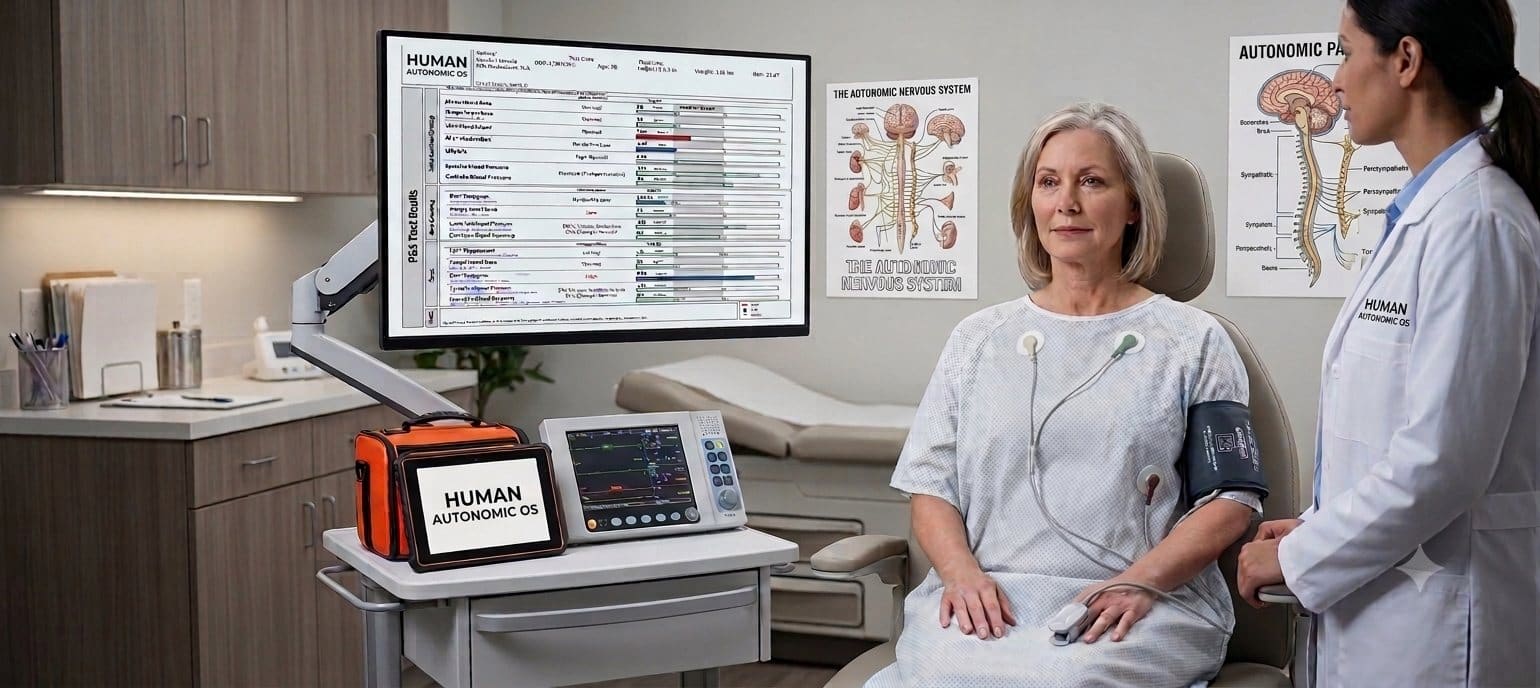
Patient seated, leads placed
A heart rate monitor, ECG leads and a blood pressure cuff. Nothing invasive, no tilt table.
Both branches resolved separately
The software measures RFa and LFa, giving parasympathetic and sympathetic activity as two independent readings.
Report before the patient leaves
Qualitative, quantitative and graphical output, ready for your review and for the patient to take home.
— Billing and Setup
Supported by Fundable Billing Codes
The assessment is supported by fundable billing codes, adding a documented revenue stream to your practice without adding staff burden.
Training and certification are included, so your team is ready from day one.
Ask about billing code applicability for your specialty during your demo.
✓ FDA 510(k) Cleared
✓ Patented Technology
✓ Backed by Published Research
✓ In Business Since 2019
— CONDITIONS
Primary Care Conditions Where Autonomic Data Helps
Drawn from the full index of forty-three, these are the presentations most common in general practice.
Diabetes
Both types are characterised by sympathetic excess, then by the continuing effects of sugar acidosis on the vagus nerve.
Post-COVID / Long-COVID
Autonomic dysfunction from a variety of causes, including the diagnosis and treatment of post-COVID symptoms.
Anxiety and Depression
Two measurable patterns rather than one diagnosis of exclusion.
Dizziness and Lightheadedness
Multiple causes, especially in geriatrics; monitoring separates the autonomic component.
Thyroid Disorders
Hyperthyroidism is characterised by sympathetic excess, hypothyroidism by parasympathetic excess.
Hypertension
Sympathetic excess drives up the baroreceptor reflex, beginning with a decline in resting parasympathetic activity.
Sleep Disorders
Night-time sleeplessness is associated with sympathetic excess; daytime sleepiness with parasympathetic excess.
Irritable Bowel Syndrome
Constipation follows parasympathetic insufficiency; diarrhoea follows parasympathetic excess and raised motility.
Morbid Obesity
Either stress-induced challenge PE putting the body into starvation mode, or a resting low sympathetic baseline keeping metabolism low.
— In the Room
What the Visit Looks Like
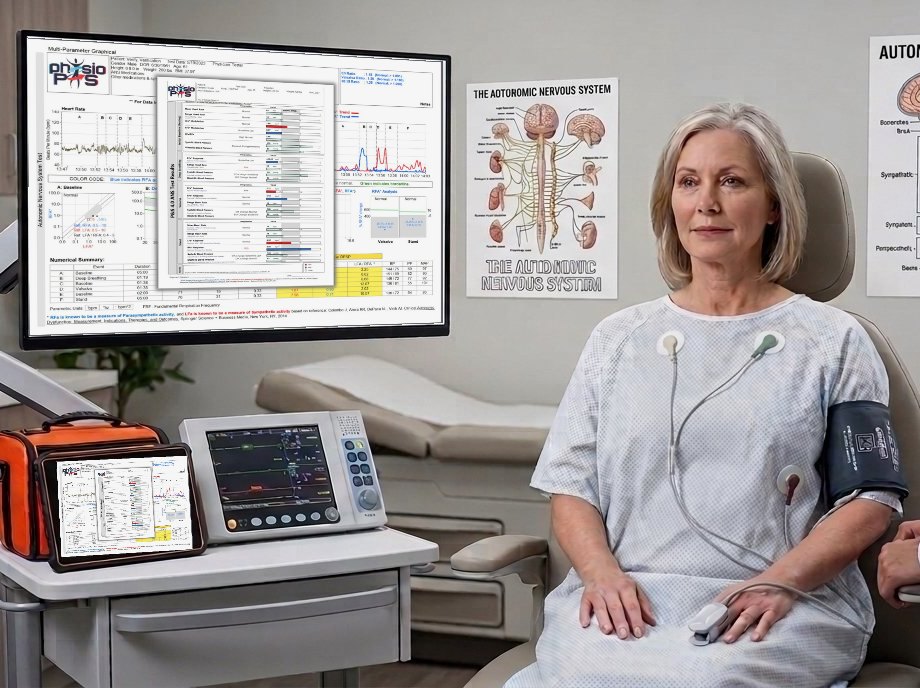
Patient seated, leads placed
A heart rate monitor, ECG leads and a blood pressure cuff. Nothing invasive, no tilt table.
Both branches resolved separately
The software measures RFa and LFa, giving parasympathetic and sympathetic activity as two independent readings.
Report before the patient leaves
Qualitative, quantitative and graphical output, ready for your review and for the patient to take home.
— Billing and Setup
Supported by Fundable Billing Codes
The assessment is supported by fundable billing codes, adding a documented revenue stream to your practice without adding staff burden. Training and certification are included, so your team is ready from day one.
Ask about billing code applicability for your specialty during your demo.
✓ FDA 510(k) Cleared
✓ Patented Technology
✓ Backed by Published Research
Expand Your Services. Create New Revenue Opportunities.
Keep your current patients. Expand the conditions you address. Grow your practice.
Your existing patient base may present opportunities to expand the services your practice provides. Physio PS provides objective autonomic nervous system data that can give you additional insight into patient function and support a more informed approach to patient assessment and ongoing care.
Explore the opportunity to better assess and monitor patients experiencing:

Long COVID & Post-Infection Syndromes
Behavioral Health: PTSD, Bipolar Disorder, ADHD, OCD, Anxiety, and Depression
Difficult-to-Control Conditions: Hypertension, Diabetes, Heart Disease, Arrhythmias, and Asthma
Women's Health
Hypermobility & Ehlers-Danlos Syndrome (EDS)
Syncope
Fatigue
Lightheadedness
Headaches & Migraines
Make Objective Data Part of Your Practice.
P&S Monitoring provides objective information about sympathetic and parasympathetic nervous system function. This additional insight can support patient assessment, help providers monitor changes over time, and inform clinical decision-making.
Your patients are already coming to your practice. Give yourself more ways to understand their needs.
— Next Step
Start Where It Makes Sense for You
FDA 510(k) cleared autonomic nervous system monitoring for clinics, home care and research. Serving physicians, clinics and researchers across the United States and worldwide.
Site
Who We Serve
Journal
Contact
603-287-1817
80 Nashua Rd, Building C, Unit G1, Londonderry, NH 03053
© 2026 Physio PS, Inc. All rights reserved. FDA 510(k) cleared · Patented · Established 2019.
Hours available on request, ask during your demo.
Copyright 2026 Physio PS, Inc. All Rights Reserved.
The material and information provided by Physio PS is for general information purposes only. You should not rely upon this material or information for basis of making healthcare, treatment, or diagnosis decisions. While Physio PS strives to provide the most correct and up-to-date information and data, Physio PS makes no representations or warranties of any kind, expressed or implied, about the completeness, accuracy, reliability, suitability, or availability with respect to the information, products, services, or related graphics contained. Any reliance placed on such material is therefore strictly at your own risk. Reporting Information is supplied under license by NCRC LLC. * ‘RFa’ is known to be a measure of Parasympathetic activity and ‘LFa’ is known to be a measure of Sympathetic activity, based on reference: Colombo J, Arora RR, DePace NL, Vinik AI, Clinical Autonomic Dysfunction: Measurement, Indications, Therapies, and Outcomes. Springer Science + Business Media, New York, NY; 2014.
— FAQ
Questions Practices Ask Before They Start
Straight answers on time, cost, clearance and fit.
How long does an assessment take?
A complete autonomic assessment is non-invasive and takes 15 minutes. It is fully automated, and the qualitative, quantitative and graphical reports are delivered without manual interpretation.
Is the technology FDA cleared?
Yes. The platform is FDA 510(k) cleared to U.S. medical device standards, patented, and backed by published research.
How is testing paid for?
The Clinical Monitoring Unit is supported by fundable billing codes. For the other systems, ask about billing code applicability during your demo. Financing options, low monthly payments and veteran-owned discounts are available to qualifying practices.
Do we need extra staff, space or a tilt table?
No. Testing integrates with your existing treatment protocols with no workflow overhaul and no tilt table required. Training and certification are included, so your team is ready from day one.
How is this different from heart rate variability tools?
It is the only solution on the market that measures both parasympathetic and sympathetic branches independently, simultaneously and quantitatively, rather than reporting one blended figure.
Which system fits my practice?
The CMU is a desktop system for clinics, the RMU is tablet-based and battery-powered for home care and sports medicine, and the PAL is laptop-based for medical professionals who move between facilities. A free demo is the quickest way to find the right configuration.
How do I become a distributor?
Tell us about your territory and the clinics you work with through the distributor enquiry form, or call 603-287-1817, and the team will follow up to discuss distribution.
Expand Your Services. Create New Revenue Opportunities.
keep your current patients. Expand the conditions you address. Grow your practice.
Your existing patient base may present opportunities to expand the services your practice provides. Physio PS provides objective autonomic nervous system data that can give you additional insight into patient function and support a more informed approach to patient assessment and ongoing care.
Explore the opportunity to better assess and monitor patients experiencing:

Make Objective Data Part of Your Practice.
P&S Monitoring provides objective information about sympathetic and parasympathetic nervous system function. This additional insight can support patient assessment, help providers monitor changes over time, and inform clinical decision-making.
✓ Your patients are already coming to your practice. Give yourself more ways to understand their needs.
— Next Step
Start Where It Makes Sense for You
FDA 510(k) cleared autonomic nervous system monitoring for clinics, home care and research. Serving physicians, clinics and researchers across the United States and worldwide.
Site
Who We Serve
Journal
Contact
603-287-1817
80 Nashua Rd, Building C, Unit G1, Londonderry, NH 03053
© 2026 Physio PS, Inc. All rights reserved.
FDA 510(k) cleared · Patented · Established 2019.
Hours available on request, ask during your demo.
Copyright 2026 Physio PS, Inc. All Rights Reserved.
The material and information provided by Physio PS is for general information purposes only. You should not rely upon this material or information for basis of making healthcare, treatment, or diagnosis decisions. While Physio PS strives to provide the most correct and up-to-date information and data, Physio PS makes no representations or warranties of any kind, expressed or implied, about the completeness, accuracy, reliability, suitability, or availability with respect to the information, products, services, or related graphics contained. Any reliance placed on such material is therefore strictly at your own risk. Reporting Information is supplied under license by NCRC LLC. * ‘RFa’ is known to be a measure of Parasympathetic activity and ‘LFa’ is known to be a measure of Sympathetic activity, based on reference: Colombo J, Arora RR, DePace NL, Vinik AI, Clinical Autonomic Dysfunction: Measurement, Indications, Therapies, and Outcomes. Springer Science + Business Media, New York, NY; 2014.